
“AI created software is coming faster and faster. And the technology to do it is already here. All that is needed is training data and a focus.”
Artificial Intelligence will create, test, and deliver software products with accuracy, efficiency, and security. Specialized AI agents will coordinate development across distinct lifecycle phases at inhuman speeds.
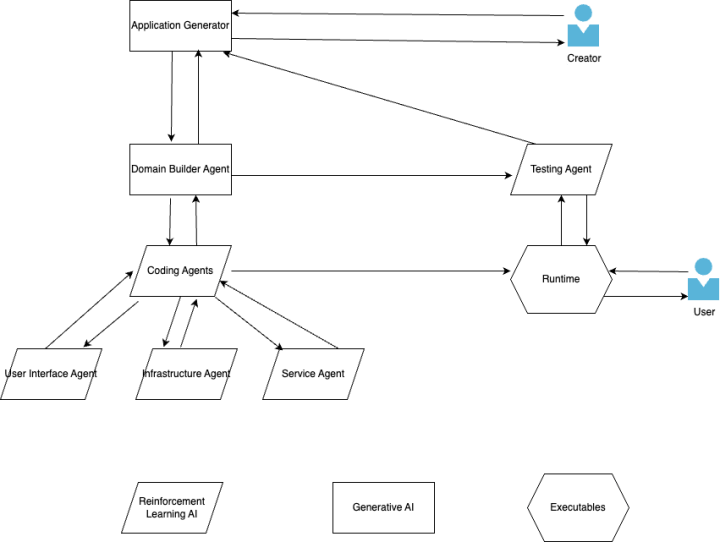
How Will It Work?
A software creator describes their product to an Application Generator (AG), which uses large language models to analyze requirements and interact with the creator to refine them. The AG works alongside a Domain Modeler to establish specifications using domain-specific language.
Once the model is validated, specialized Coding Agents build the software:
- User Interface Agent: Develops the front-end with intuitive, responsive interfaces
- Infrastructure Agent: Handles databases, infrastructure as code, and shared services
- Service Agent: Creates business logic and service layers
After development and initial testing (security, unit tests, performance), a Testing Agent performs comprehensive evaluation including functionality, usability, and load testing.
1. Revolutionizing Software Engineering with AI
“Software engineering is a set of repeatable tasks.”
AI impacts multiple lifecycle areas:
Design: Most software follows similar foundational principles. Agents can leverage established best practices to deliver optimal outcomes.
Coding: Programming languages operate as grammars with foundational components. While implementations vary, superior approaches exist, creating a finite set of optimal solutions.
Testing: Synthetic data generation combined with reinforcement training, alongside Large Action Models, could produce genuinely bug-free software—architecture or business logic flaws notwithstanding.
Support Lifecycle: AI can write user documentation during development, manage documentation, respond to support tickets, and create dynamic bindings between software versions.
2. The Evolution of Software Practices
Source Control: Feature flagging becomes more relevant, providing agents better context about capabilities and testing requirements.
Requirements Tracking: Historical context and current state documentation retain value for AI-driven development conversations with software creators.
Software Security: Security testing persists through specialized agents, while Application Generators and Domain Builders better handle access controls and business logic security.
3. Behavioral Psychology: Adapting to Rapid Changes
Impact on Users: Rapid release cycles risk user fatigue. Keeping pace with continuous feature deployment can reduce productivity as users struggle with perpetual change.
The Creator’s Paradox: While execution costs decrease through automation, decision complexity increases. Software creators must balance rapid change capability against decision fatigue and user stability needs.
“Software is going to be created and changed at speeds that we are not used to.”
Both product owners and users require adjustment as development velocity accelerates dramatically.