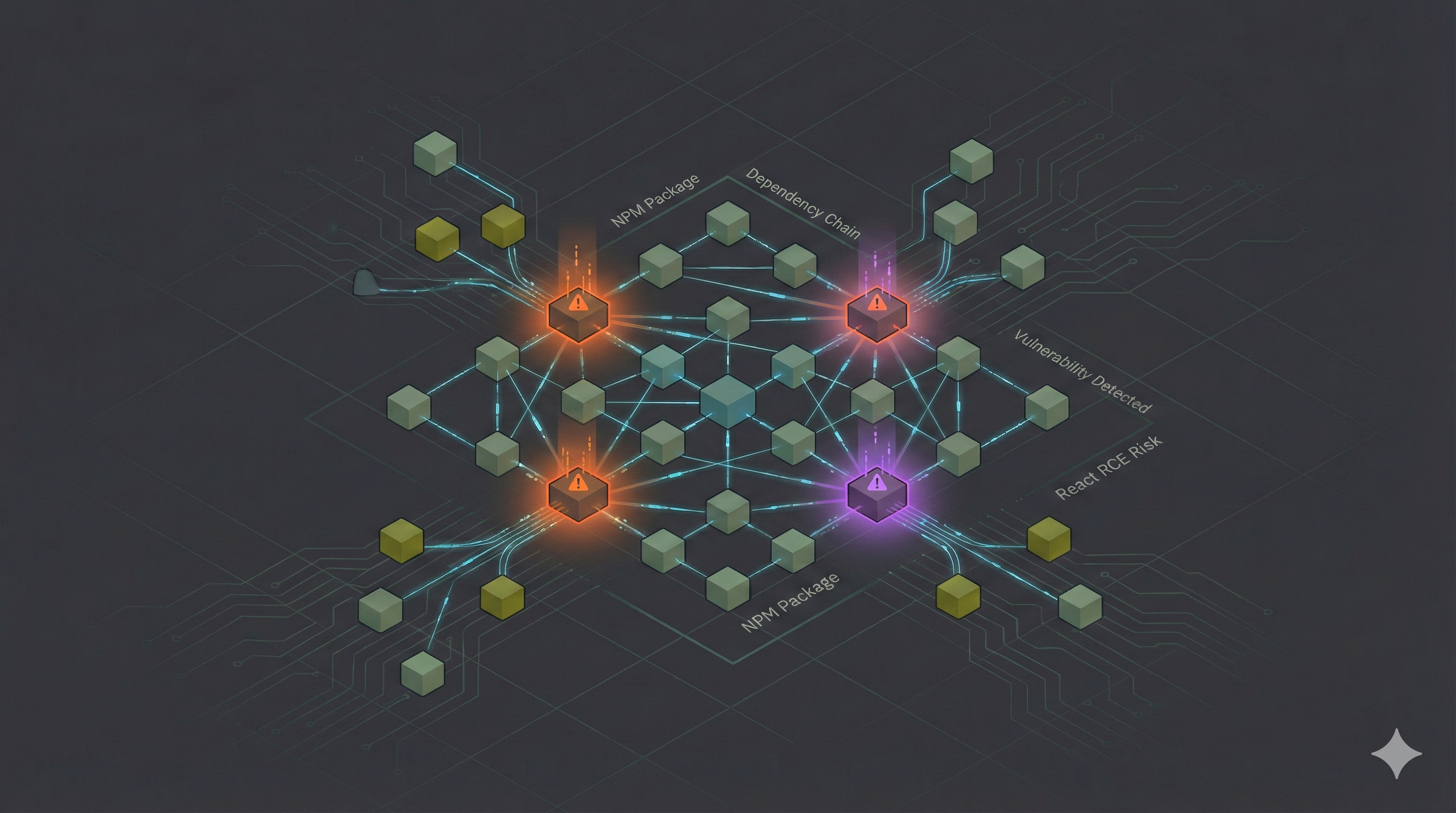
 Caption: The modern software supply chain - a complex web of dependencies requiring constant vigilance
On December 3, 2025, React—one of the world’s most trusted JavaScript frameworks—disclosed CVE-2025-55182, a vulnerability with a perfect CVSS 10.0 score. Within hours, threat groups were actively exploiting it. The attack vector? A flaw in React Server Components that allowed unauthenticated remote code execution with a single HTTP request. Security researchers discovered that 39% of cloud environments were vulnerable.
This wasn’t an obscure package maintained by a single developer. This was React—backed by Meta, downloaded over 20 million times per week, and trusted by millions of applications worldwide. If React can harbor a critical vulnerability, what does that say about the thousands of less-scrutinized dependencies in your node_modules folder?
The software supply chain has become the battlefield of modern cybersecurity. NPM’s ecosystem hosts over 2.5 million packages, representing millions of potential entry points into production systems. Recent attacks—from the React RCE to the self-replicating Shai-Hulud 2.0 worm—demonstrate that supply chain vulnerabilities aren’t theoretical risks. They’re clear and present dangers.
This article examines the current state of NPM supply chain security through three lenses: the anatomy of recent attacks, the problem of dependency bloat and how much code we actually use, and the emerging role of AI in both creating and solving security vulnerabilities. You’ll learn practical strategies for dependency management, upgrade policies, and how to evaluate AI-powered security tools for your context.
The Perfect Storm: Recent NPM Supply Chain Attacks
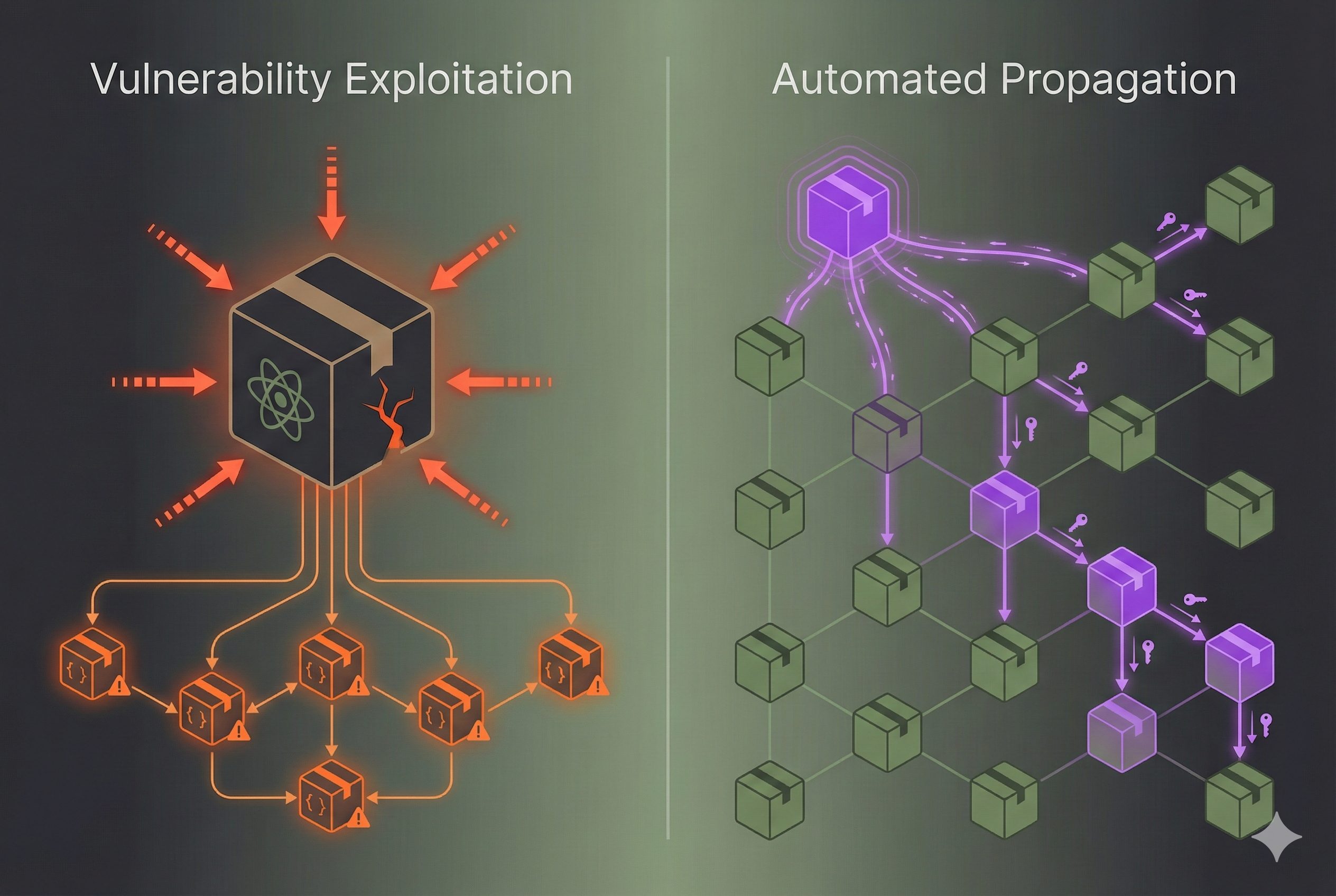 Caption: Major NPM supply chain attacks of 2025 - from framework vulnerabilities to self-replicating worms
The NPM ecosystem faced a cascade of sophisticated attacks in 2025, each revealing different vulnerabilities in the software supply chain. These weren’t isolated incidents—they represented an evolution in attack sophistication and scale.
The React RCE Vulnerability (CVE-2025-55182)
The React vulnerability exemplifies how even the most trusted code can become a weapon. CVE-2025-55182 affects React 19.x and Next.js applications that implement React Server Components. The vulnerability stems from insecure deserialization in the “Flight” protocol—the mechanism React uses to stream server components to the client.
An attacker could exploit this by sending a specially crafted HTTP request to any vulnerable endpoint. No authentication required. No user interaction needed. Just one malicious request to achieve remote code execution on the server.
The real-world impact was immediate and severe. Security firm Upwind reported that 39% of the cloud environments they scanned were vulnerable. More concerning, threat intelligence identified exploitation attempts within hours of the public disclosure. China-nexus threat groups including Earth Lamia and Jackpot Panda were observed actively targeting vulnerable instances.
The takeaway is sobering: framework-level vulnerabilities affect every application built on them. When a dependency this fundamental is compromised, the blast radius extends across the entire ecosystem. Patching wasn’t optional—it was an emergency.
The Shai-Hulud 2.0 Worm Attack
While the React vulnerability was a flaw in trusted code, Shai-Hulud 2.0 represented a different threat vector: malicious code spreading through the dependency graph itself. Named after the sand worms from Dune, this attack demonstrated how supply chain compromises can self-propagate at machine speed.
The attack began in late November 2025 when attackers compromised NPM maintainer accounts through sophisticated phishing campaigns. Once inside, they published malicious versions of legitimate packages. The payload was a self-replicating worm designed to spread across repositories, compromise additional maintainer accounts, and harvest credentials.
The scale was unprecedented. By the time the attack was contained, over 25,000 repositories had been compromised across approximately 500 GitHub users. The malicious code was found in roughly 27% of cloud and code environments scanned by security firm Wiz. Perhaps most alarming: the attack accelerated at approximately 1,000 new repositories every 30 minutes during its peak.
The worm’s payload targeted valuable credentials—GitHub personal access tokens and API keys for AWS, Google Cloud Platform, and Azure. It automated the entire attack lifecycle: compromise an account, inject malicious code, harvest credentials, identify new targets, repeat. The dependency graph that makes NPM convenient became the attack’s propagation mechanism.
The Trust Problem in Open Source
These high-profile attacks illuminate a fundamental tension in the NPM ecosystem. With over 2.5 million packages and thousands of new releases daily, the sheer velocity makes comprehensive security review impossible.
Consider the September 2025 attack that compromised 18 widely used packages including chalk, debug, ansi-styles, and strip-ansi. These packages collectively see over 2.6 billion downloads each week. During the two-hour window when malicious versions were available, the compromised code reached 1 in 10 cloud environments. Two hours. Ten percent of cloud environments. The window between compromise and impact has collapsed to nothing.
The maintainer burden compounds the problem. Many popular packages are maintained by small teams or even single developers—often as unpaid open source work. Abandoned packages remain in the ecosystem, still depended upon but no longer actively monitored for security issues. Attackers exploit this through typosquatting (registering packages with names similar to popular libraries) and by targeting maintainer accounts through social engineering.
The NPM ecosystem’s openness enables its innovation and growth. That same openness makes it a target. Trust, once assumed, now requires constant verification.
The Dependency Bloat Crisis: How Much Code Are We Actually Using?
 Caption: The reality of dependency bloat - over 50% of dependencies contain code that never executes
Supply chain vulnerabilities aren’t just about malicious actors. They’re also about attack surface. Every line of code in your dependencies is a potential vulnerability—and research shows most of it never executes.
The Reality of Unused Code
Recent research paints a troubling picture of dependency utilization. A 2024 study analyzing the PyPI Python ecosystem found that more than 50% of dependencies are bloated—meaning they contain code the project never uses. In terms of actual lines of code, 34% of dependency code is bloated on average.
A parallel study of CommonJS packages (the NPM ecosystem) found even starker results: 25,566 dependencies—representing 50.6% of the total—were never accessed at runtime. More than half of the 91 packages studied had at least one direct bloated dependency. When researchers removed 120 direct bloated dependencies, 4,167 indirect (transitive) dependencies were also eliminated.
Think about what this means for security. You’re importing a library to use one function. That library depends on five other libraries. Those libraries have their own dependencies. Suddenly, your “left-pad” equivalent has pulled in thousands of lines of code, and you’re assuming the security burden for all of it—even though 99% never executes in your application.
The “left-pad” incident of 2016 illustrated this perfectly. When a developer removed an 11-line package from NPM, thousands of projects broke because they depended on it—often indirectly, through dependency chains they didn’t even know existed. The lesson wasn’t just about availability. It was about the absurdity of massive dependency trees for trivial functionality.
Attack Surface Expansion
Every dependency is a potential vulnerability. Every transitive dependency multiplies the risk. Research shows that 15% of defects in the PyPI ecosystem reside in bloated areas of packages—code that isn’t even being used but is still present and exploitable.
Consider a hypothetical attack scenario: Your application uses Library A for one utility function. Library A depends on Library B for JSON parsing. Library B depends on Library C for schema validation. Library C has a remote code execution vulnerability in its YAML parsing functionality—a feature your application never touches.
Are you vulnerable? Yes. The malicious code is in your bundle. A clever attacker might find a way to trigger that unused code path through unexpected inputs or by chaining vulnerabilities. Even if the code never executes in normal operation, its presence expands your attack surface.
The September 2025 NPM attack demonstrated this principle at scale. Many affected applications didn’t directly depend on the compromised packages like chalk or debug. They were transitive dependencies—pulled in by other dependencies, often several layers deep. Developers didn’t choose to trust these packages. They inherited that trust implicitly.
Measuring and Reducing Dependency Bloat
The first step to managing bloat is visibility. Software Bill of Materials (SBOM) tools like Syft and CycloneDX create comprehensive dependency inventories. These tools analyze your project and produce a structured list of every dependency—direct and transitive—including versions, licenses, and known vulnerabilities.
Bundle analyzers show what code actually ships to production. Tools like webpack-bundle-analyzer and source-map-explorer visualize your JavaScript bundles, revealing which dependencies contribute most to bundle size. Tree-shaking (dead code elimination) helps, but it’s imperfect. Many dependencies use patterns that prevent effective tree-shaking, and tree-shaking only addresses client-side bundles, not server-side runtime risk.
The most effective strategy is conscious dependency selection. Before adding a new dependency, evaluate:
- Can this functionality be implemented directly in reasonable time?
- Does this library do one thing well, or is it a swiss-army knife where we only need the screwdriver?
- Are there lighter alternatives with similar capabilities?
- How many transitive dependencies does this add?
A practical example: replacing moment.js (a comprehensive date library with many dependencies) with date-fns (modular, tree-shakeable alternatives) or the built-in Intl API can eliminate hundreds of kilobytes of code and dozens of dependencies. The functionality remains; the attack surface shrinks.
Dependency bloat isn’t just a performance problem. It’s a security liability. Every line of unused code in your dependencies is a line you’re responsible for securing but can’t inspect or control.
Third-Party Upgrade Strategies: Balancing Security and Stability
Even with minimal, carefully selected dependencies, they still need updates. This creates a tension between security and stability that every development team must navigate.
The Update Dilemma
Staying current is a security imperative. Known vulnerabilities don’t go away because you ignore them—they become increasingly attractive targets as exploit code becomes public and automated scanning tools add them to their databases. The React RCE demonstrated this: exploitation began within hours of disclosure. If you’re not patched, you’re vulnerable.
But updates carry risk. Major version upgrades often include breaking changes. APIs get deprecated. Configuration formats change. What worked yesterday might fail tomorrow. The friction of dealing with breaking changes creates a powerful incentive to delay updates: “If it’s not broken, don’t fix it.”
The problem is that delayed updates accumulate technical debt. The longer you wait, the larger the gap between your current version and the latest secure version. A six-month delay might span two major versions, each with breaking changes. The upgrade becomes so daunting that it gets delayed further. Teams end up running dependencies that are years out of date, with dozens of known vulnerabilities—because the cost of upgrading seems higher than the abstract risk of exploitation.
Until it isn’t abstract anymore. Until it’s a CVSS 10.0 vulnerability being actively exploited, and you’re facing an emergency patch with breaking changes in production.
Best Practices for Dependency Management
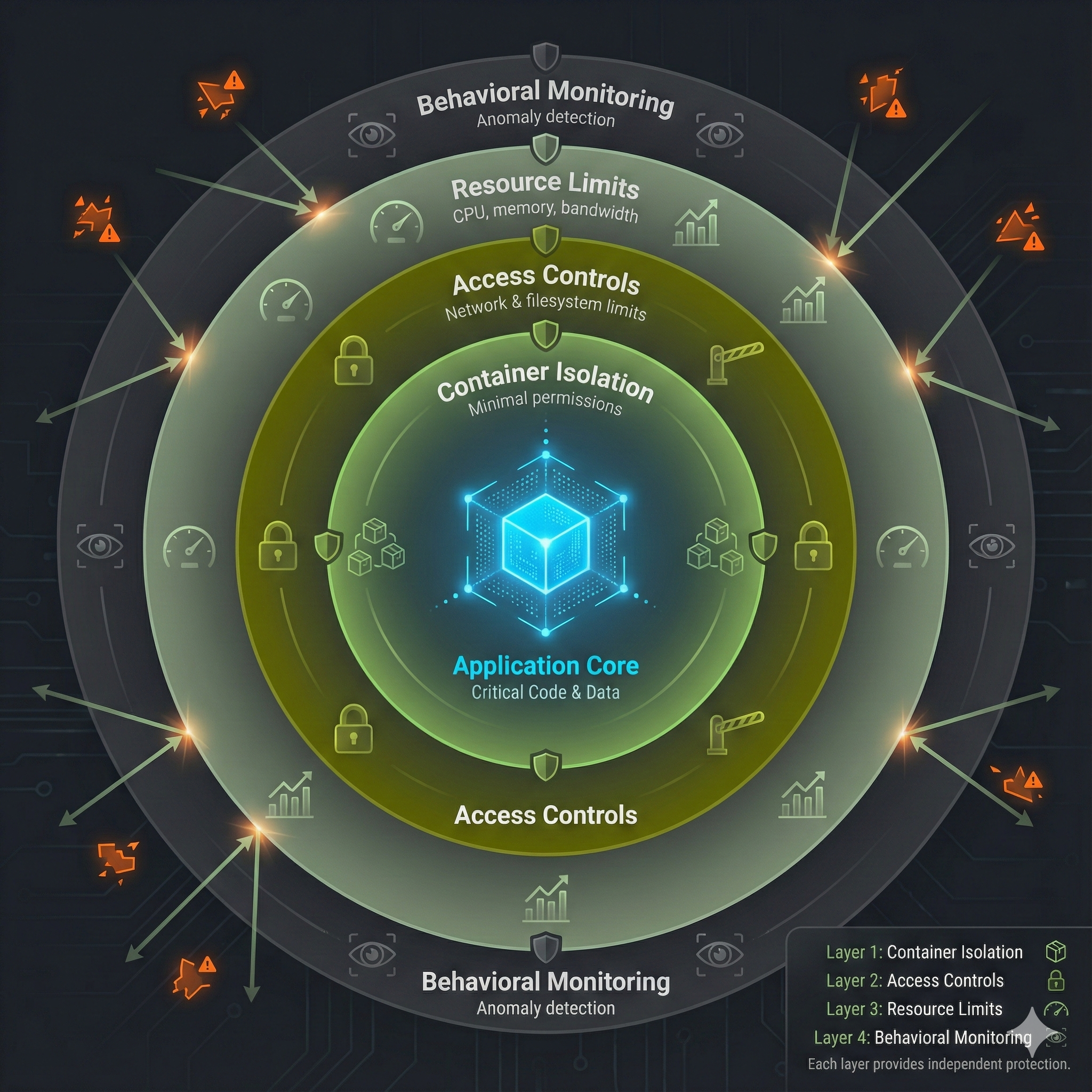 Caption: Defense in depth for dependency security - multiple layers of protection from selection to runtime
Effective dependency management requires process, tooling, and discipline across multiple layers.
Inventory and Visibility
You can’t secure what you don’t know about. Maintaining a comprehensive SBOM provides the foundation for all other dependency security practices. Your SBOM should track:
- All direct dependencies (what you explicitly added to package.json)
- All transitive dependencies (what your dependencies depend on)
- Why each dependency exists (what functionality it provides)
- License information (ensuring legal compliance)
- Known vulnerabilities (from public databases like CVE and GitHub Security Advisories)
Modern SBOM tools integrate with package managers and build systems to automatically generate and update these inventories. The SBOM becomes your map of the dependency terrain—showing you where risk concentrates and what would be affected by specific vulnerabilities.
Version Control Strategies
Lock files (package-lock.json for NPM, yarn.lock for Yarn) provide deterministic builds by pinning exact versions of all dependencies. This prevents unexpected changes when running npm install on different machines or at different times. Lock files are essential for production deployments—you need to know exactly what code is running.
But lock files create a maintenance obligation. They don’t automatically update when security patches are released. You need active dependency management to identify when updates are available and make conscious decisions about when to update the lock file.
Version pinning (using exact versions like “3.2.1” instead of ranges like “^3.2.0”) provides maximum control but maximum maintenance burden. Semantic versioning is supposed to make ranges safe—a patch version should never break your code. In practice, packages don’t always follow semantic versioning correctly, and even patch versions occasionally introduce breaking changes or new bugs.
The pragmatic approach: use lock files for deterministic builds, but run automated tools regularly to identify when security updates are available. Review and test updates in staging environments before updating production lock files.
Automated Vulnerability Scanning
Manual dependency auditing doesn’t scale. Automated scanning tools integrate at multiple points in the development lifecycle:
IDE Integration: Tools like Snyk and Dependabot can flag vulnerable dependencies as you write code, providing immediate feedback before changes are even committed.
Pre-commit Hooks: Running npm audit or similar tools as part of pre-commit hooks prevents vulnerable dependencies from entering the repository. This can be too strict for active development (blocking commits entirely) but valuable for enforcing policy.
CI/CD Pipeline: Vulnerability scanning in continuous integration catches issues before they reach production. Failed security scans can block deployments, forcing resolution before release.
Deployment Gates: Some organizations implement security gates that prevent deploying applications with known critical or high-severity vulnerabilities. This is the last line of defense.
The challenge is alert fatigue. A typical NPM project might have dozens or hundreds of vulnerabilities flagged, many of them low severity or in transitive dependencies you don’t directly control. Effective scanning requires prioritization: focus on critical and high-severity issues first, exploitable vulnerabilities before theoretical ones, and direct dependencies before transitive ones.
Isolation and Defense in Depth
Even with perfect dependency management, assume dependencies might be compromised. Isolation limits the blast radius.
Container isolation (Docker, Kubernetes) with minimal permissions provides a security boundary. Run application code with only the filesystem access, network access, and system capabilities it actually needs. A compromised dependency running in a tightly restricted container might not be able to exfiltrate data or establish command-and-control communications.
Network and filesystem access restrictions are particularly effective. If your application doesn’t need to make outbound HTTPS connections except to specific APIs, block all other outbound traffic. If it doesn’t need to write to certain directories, make them read-only.
Resource limits prevent certain classes of attacks. A supply chain attack that attempts to mine cryptocurrency or launch denial-of-service attacks will consume CPU, memory, or network bandwidth. Monitoring for unusual resource consumption and automatically terminating processes that exceed limits can detect and contain compromises.
Behavioral anomaly detection looks for suspicious patterns: unexpected network connections, file system modifications, or process spawning. While not specific to supply chain attacks, these techniques create layers of defense beyond “trust the dependencies.”
Dependency Selection Criteria
The best way to avoid vulnerable dependencies is not to include them in the first place. Before adding a new dependency, evaluate its security posture:
Repository Activity: Is the project actively maintained? Recent commits, frequent releases, and responsive maintainers suggest ongoing attention to security issues. Abandoned projects won’t receive security patches when vulnerabilities are discovered.
Contributor Diversity: A project with multiple active contributors is more resilient than a project maintained by a single developer. If the sole maintainer’s account is compromised (as happened in the Shai-Hulud attack), the entire project is compromised.
Security Track Record: How has the project handled past vulnerabilities? Do they have a documented security policy? Do they participate in coordinated disclosure? Do they publish security advisories? A good track record suggests a security-conscious project.
Community Size: Popular projects with large user bases benefit from more scrutiny. More users means more people looking at the code, more security researchers investigating it, and faster identification of vulnerabilities. Obscure packages with few users may harbor undiscovered vulnerabilities.
Red Flags:
- Single maintainer with no recent activity
- No security policy or contact information
- No response to reported issues
- Frequent major version changes (suggests instability)
- Unusually small package with large dependency tree
Vetting dependencies before adoption is easier than responding to incidents after compromise. Make dependency selection a deliberate decision, not a reflex.
Continuous Update Strategy
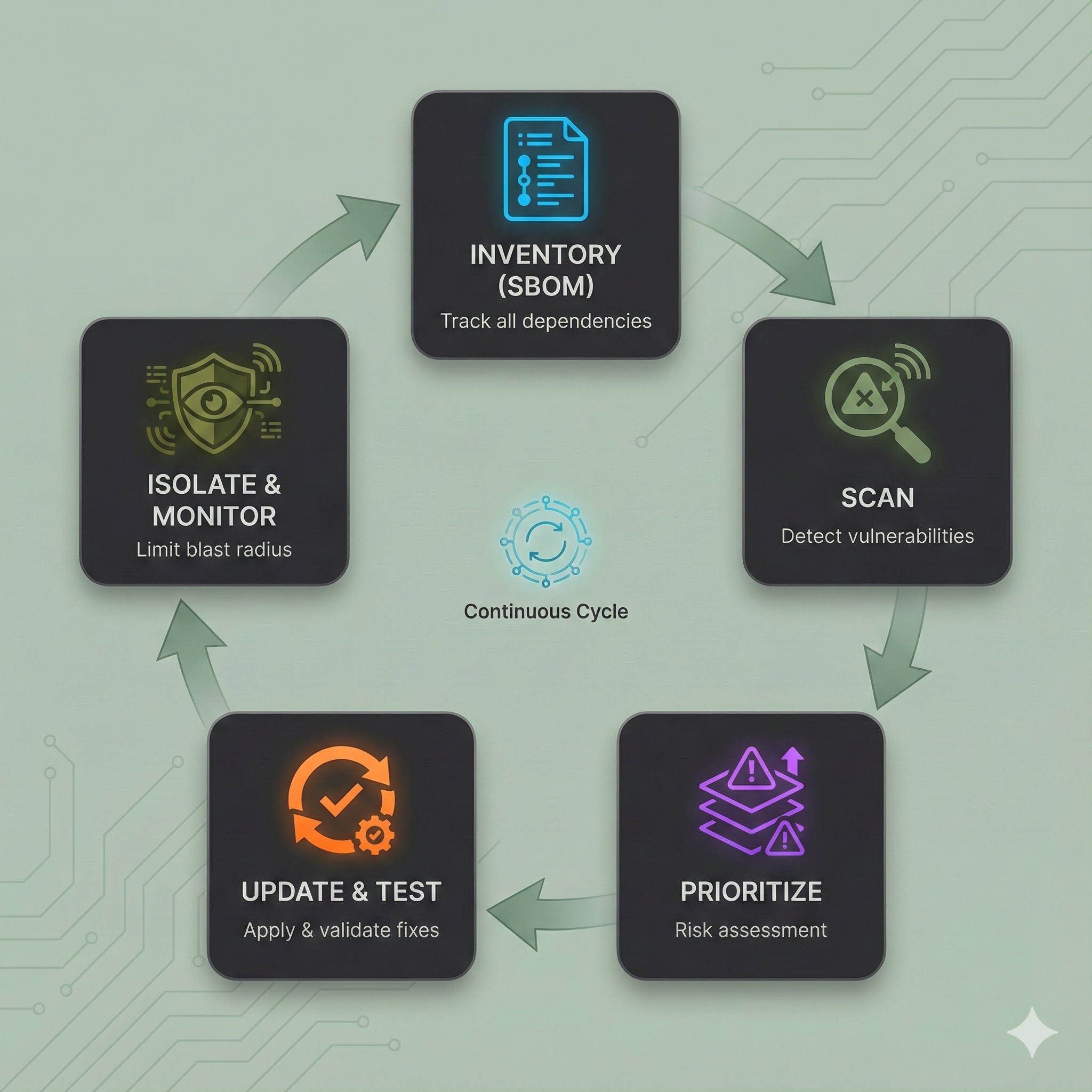 Caption: Continuous update strategy - frequent small updates reduce risk and technical debt
The safest approach to updates is frequent, small updates rather than infrequent, large updates. This mirrors modern deployment practices: smaller changes are easier to test, easier to debug if something breaks, and easier to roll back.
Establish a regular update cadence. Some teams update dependencies weekly or bi-weekly, reviewing available updates, evaluating their risk, and deploying them through staging environments before production. This creates a rhythm where updates are routine rather than exceptional.
Automated testing provides the safety net that makes frequent updates viable. Comprehensive test suites catch breaking changes before they reach production. The better your test coverage, the more confidently you can update dependencies.
Staged rollouts reduce risk further. Deploy updates to a small percentage of production traffic first (canary deployment) and monitor for errors, performance degradation, or other issues. If problems emerge, they affect only a small fraction of users and can be quickly rolled back.
The update review process should balance speed and safety. Critical security updates (like the React RCE) demand immediate action. Low-severity updates or major version changes can be batched and planned. The key is having a process that can respond at the speed required by the severity of the issue.
AI-Powered Solutions: Auto-Patching and Secure Code Generation
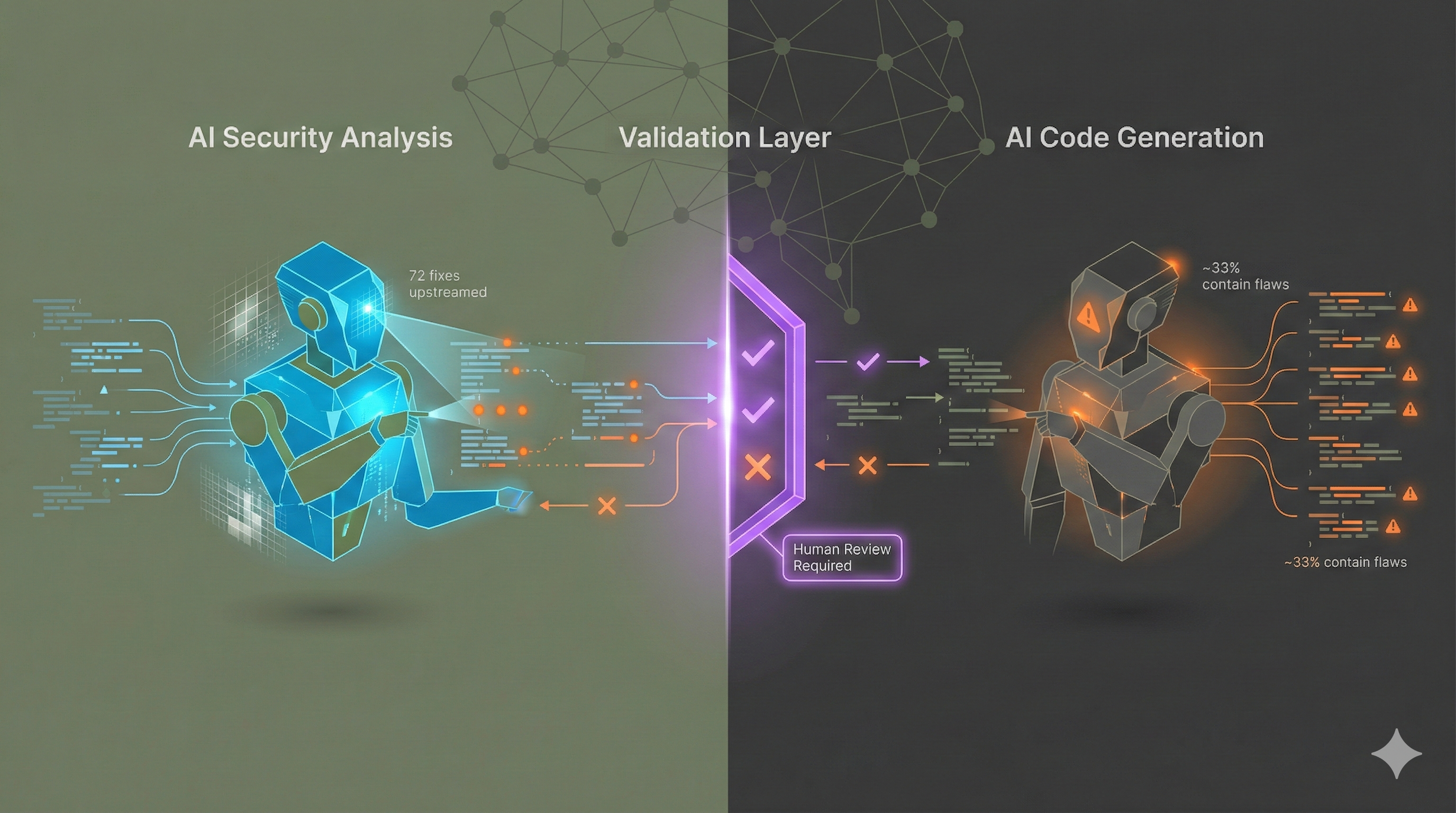 Caption: AI in supply chain security - from automated vulnerability detection to intelligent patch generation
As supply chain vulnerabilities accelerate in frequency and sophistication, AI-powered security tools promise to defend at machine speed. The promise is compelling—but the reality is more nuanced.
The Promise of AI-Automated Patching
Google DeepMind’s CodeMender represents one of the most mature AI patching systems deployed at scale. CodeMender uses Gemini Deep Think models to autonomously analyze vulnerabilities, understand the code context, and generate patches. As of 2025, CodeMender has contributed 72 security fixes to open-source projects, including codebases with over 4.5 million lines of code.
The workflow is instructive. When a vulnerability is detected—typically through fuzzing, static analysis, or security scanning—CodeMender analyzes the vulnerable code, understands the security issue, proposes a fix, and generates a patch for human review. Critically, these are not automatically applied. Human developers review the patches, test them, and decide whether to merge them.
Google reports that their broader automated patching pipeline achieves a 15% fix rate for sanitizer bugs—memory safety violations detected during testing. This means that for every 100 bugs identified, the AI successfully generates patches for 15 that pass review and get merged into the codebase. That might not sound impressive until you consider the alternative: those are 15 bugs that would have required hours of developer time each to understand, fix, and test.
Industry Solutions and Benchmarks
Multiple organizations are developing AI-powered patching solutions, each with different approaches and success rates:
Snyk AI reports an 84% reduction in mean time to remediate (MTTR)—the time from vulnerability detection to deployment of a fix. This doesn’t mean AI automatically fixes 84% of vulnerabilities. It means that across all vulnerabilities, the average time to fix them decreased by 84% when AI assistance was available. The AI might suggest patches, prioritize issues, or guide developers to the vulnerable code more quickly.
PatchitPy, a research project focused on Python vulnerabilities, achieves a 93% F1 score for vulnerability detection and an 80% repair rate. These are promising numbers, but they’re from a controlled research environment with specific types of vulnerabilities, not the messy reality of production codebases.
Meta’s AutoPatchBench provides a standardized benchmark for evaluating AI patching systems, focusing on C/C++ bugs identified through fuzzing. This benchmark is important because it creates a common baseline for comparing different AI approaches. As of 2025, various AI systems show success rates ranging from 10% to 40% depending on the bug type and codebase.
OpenAI’s Aardvark agent, introduced in 2025, focuses on vulnerability detection rather than patching. In benchmark testing, Aardvark identified 92% of known and synthetically-introduced vulnerabilities, demonstrating high recall. Detection is the easier problem—patching requires understanding how to fix the issue without breaking functionality.
The Security Risks of AI-Generated Code
While AI tools promise to fix vulnerabilities, they also introduce new ones. Research indicates that approximately one in three AI-suggested code snippets contains exploitable flaws. This creates a paradox: the tool designed to improve security may be degrading it.
AI code generation tools like GitHub Copilot, AWS CodeWhisperer, and others learn from vast corpuses of code—including insecure code. When asked to implement authentication, the AI might suggest patterns from the training data that seemed common but contain subtle vulnerabilities. Hardcoded credentials. SQL injection vulnerabilities. Missing input validation. Cross-site scripting flaws.
Common vulnerability patterns in AI-generated code map directly to the OWASP Top 10:
- Injection flaws (SQL, command injection, XSS) from insufficient input sanitization
- Broken authentication from weak session management or password handling
- Insecure deserialization (like the React RCE)
- Use of components with known vulnerabilities
- Insufficient logging and monitoring
The problem compounds when developers trust AI suggestions implicitly. If a human security expert suggested code, you’d review it carefully. But AI-generated code often gets accepted with minimal review—especially when it “looks right” and passes basic tests.
Training data contamination exacerbates the problem. If the AI was trained on code from 2020, its suggestions might not incorporate security practices developed since then. It might suggest cryptographic libraries that are now deprecated or use patterns that seemed acceptable five years ago but are now recognized as risky.
Securing AI-Generated Code
The solution is not to avoid AI coding assistants—they provide real productivity benefits. The solution is to treat AI-generated code with appropriate skepticism.
Real-time scanning of AI suggestions before acceptance is becoming standard practice. Some organizations integrate security scanning directly into the AI coding assistant, flagging vulnerable patterns before the developer accepts the suggestion. These scanners look for common vulnerability patterns: hardcoded secrets, SQL concatenation, eval() statements, dangerous file operations.
Pattern-based vulnerability detection catches obvious mistakes. More sophisticated approaches use static analysis or even additional AI models trained specifically on security issues to evaluate suggestions from general-purpose code generation models. Essentially, AI security assistants review AI code assistants.
Human review remains essential, especially for security-critical code. Authentication systems, authorization logic, data validation, cryptographic operations, and other security-sensitive functionality should never be implemented purely from AI suggestions without careful review by someone who understands the security implications.
Integration with existing security tooling creates defense in depth. AI-generated code still goes through pre-commit hooks, CI/CD pipeline security scans, and code review. These existing processes catch many AI-introduced vulnerabilities—if they’re enforced consistently.
The Future: AI-Assisted Dependency Management
The most promising application of AI to supply chain security might not be patching individual vulnerabilities but managing the entire dependency lifecycle.
Proactive vulnerability prediction could identify potential security issues before they’re publicly disclosed. By analyzing code patterns, complexity metrics, and historical vulnerability data, AI models might flag dependencies likely to have undiscovered vulnerabilities—allowing teams to increase scrutiny or seek alternatives before CVEs are published.
Behavioral analysis for zero-day detection monitors dependencies for suspicious behavior at runtime. If a dependency suddenly starts making network connections it never made before, or accessing files outside its expected scope, that might indicate compromise—even if no vulnerability is publicly known.
Automated patch generation and testing could accelerate response to disclosed vulnerabilities. When a CVE is published, AI tools could analyze the vulnerable dependency, identify affected code in your application, generate patches or workarounds, run automated tests to verify functionality, and present the changes for review—all within minutes instead of hours or days.
Intelligent dependency upgrade recommendations could prioritize updates based on your specific usage. If a dependency has a critical vulnerability in a feature you don’t use, that’s lower priority than a high-severity vulnerability in code you call on every request. AI analysis of your codebase and the dependency’s code could provide personalized risk assessment.
Code rewrite suggestions to eliminate dependencies entirely represent the most ambitious application. If your application uses a large library for a single function, AI tools might suggest reimplementing that function directly—reducing your dependency count and attack surface. This requires high confidence in the AI’s output and thorough testing, but it could address dependency bloat at the source.
Practical Guidance for AI Tools
As AI security tools mature, development teams need frameworks for when to trust them and when to insist on human review.
Trust AI patches for:
- Low-risk dependencies (development-only, limited scope)
- Well-understood vulnerability types (known patterns like SQL injection)
- Dependencies with comprehensive test coverage (changes can be validated automatically)
- Non-critical systems (staging environments, internal tools)
Require human review for:
- Critical dependencies (authentication, authorization, data access)
- Complex vulnerabilities (requires understanding context and business logic)
- Production systems (failure has real-world impact)
- Dependencies with inadequate test coverage (can’t automatically validate behavior)
Testing requirements for AI-generated fixes should match or exceed testing for human-written code. Just because AI generated a patch doesn’t make it correct. Run unit tests, integration tests, and security-specific tests. In some cases, manual security review and penetration testing may be warranted.
Incorporating AI tools into existing security workflows prevents them from becoming silos. AI-detected vulnerabilities should flow through the same ticketing, prioritization, and remediation processes as human-detected ones. AI-generated patches should go through the same code review and testing gates as human-written patches.
Measuring effectiveness helps evaluate whether AI tools provide value. Track metrics like:
- False positive rate (AI flags vulnerabilities that aren’t real)
- False negative rate (AI misses real vulnerabilities)
- Time savings (comparing AI-assisted remediation to manual)
- Code quality (do AI patches introduce bugs or technical debt?)
AI tools are force multipliers, not replacements for security expertise. They excel at scale—analyzing thousands of dependencies, monitoring for anomalies continuously, generating patches for common vulnerability patterns. They struggle with context—understanding business logic, evaluating security-usability tradeoffs, and making judgment calls about acceptable risk.
The most effective approach combines AI automation with human expertise: let AI handle detection, initial analysis, and routine patching, while humans focus on complex vulnerabilities, architectural decisions, and high-stakes systems.
Conclusion
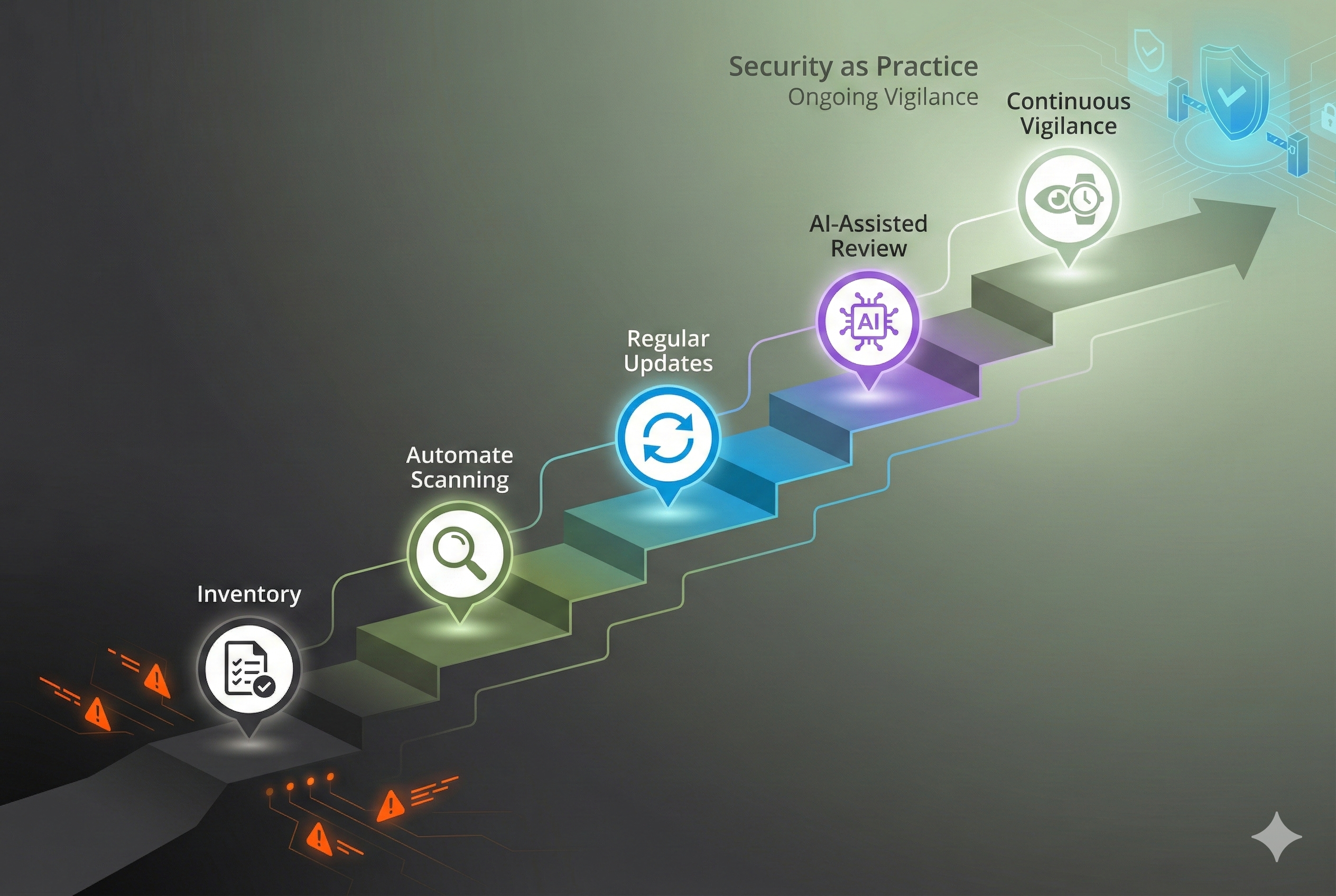 Caption: The path forward - combining automated tools, continuous monitoring, and human expertise
Supply chain vulnerabilities have evolved from theoretical concerns to immediate operational realities. The React RCE, Shai-Hulud worm, and widespread NPM compromises of 2025 demonstrate that attacks are real, sophisticated, and accelerating. Exploitation timelines have collapsed from weeks to hours. Attack automation has turned the dependency graph into a propagation mechanism. No dependency—not even those from the most trusted sources—can be assumed secure by default.
Three dimensions demand attention. First, understand and monitor the threat landscape. Supply chain attacks aren’t slowing down—they’re becoming more automated, more sophisticated, and more targeted. Staying informed about vulnerabilities in your dependencies is no longer optional. Second, manage dependencies deliberately. Minimize your dependency count, maintain comprehensive inventories, implement automated scanning, and establish regular update cadences. Every unused dependency is risk without benefit. Third, leverage AI thoughtfully. AI-powered security tools show genuine promise for vulnerability detection, patch generation, and risk assessment—but they introduce their own security challenges and require human oversight.
The fundamental tension remains: the NPM ecosystem’s openness enables its innovation but demands constant security attention. The convenience of importing any package creates security obligations for all of them. Balancing productivity with security requires tools, processes, and culture that treat dependency management as a core competency rather than an afterthought.
Start this week:
- Generate an SBOM for your critical applications and identify outdated dependencies
- Add automated vulnerability scanning to your CI/CD pipeline if it’s not already there
- Establish a regular update cadence—even monthly reviews of security updates are better than reactive patching
- Evaluate AI-powered security tools for your specific context and risk tolerance
- Review your top 10 dependencies and ask: are all of these still necessary?
Supply chain security isn’t a one-time fix. It’s an ongoing practice of vigilance, tooling, and continuous improvement. The tools are improving—from better SBOM generation to AI-powered patching—but the responsibility remains with developers to use them wisely. The dependencies you choose today define your security posture tomorrow.